
The Reserve Bank of India (RBI) has increased its GDP growth forecast for the current fiscal year (FY27) by 40 basis points to 7.1 per cent, acknowledging the resilience of domestic economic activity despite global headwinds and geopolitical tensions.

The OECD projects India's GDP to grow at 7.6% in the current fiscal year and 6.1% in 2026-27, despite global economic challenges stemming from the Middle East conflict and energy price volatility.

It now occupies Japan's position right below US and China.

Indian crypto exchanges and companies have expressed strong support for the Central Board of Direct Taxes' (CBDT) new Crypto Asset Reporting Framework (CARF), which mandates reporting and due-diligence obligations for crypto service providers on all transactions starting 2026.

Indian economy's growth is expected to be "below trend" even as neighbouring China and most of the developed nations are expected to see better prospects, according to Paris-based think tank OECD.

While most economies contracted in the second quarter of 2020, the Chinese economy grew by 3.2 per cent.

Increasing female economic participation by ensuring equal work opportunities for women and expanding access to education and skills training for female entrepreneurs.

India and China, besides some developed countries, may face economic downturn in the coming months, according to an analysis by OECD -- a grouping of mostly advanced nations.
With emerging economies facing the possibility of "abrupt slowdowns", India's Gross Domestic Product growth rate could slip to as low as 4.3 per cent in 2009, said the OECD.

American industry groups sought punitive tariffs on Indian goods at USTR hearings, while Indian officials defended the country's manufacturing growth as demand-led and WTO-compliant.

The indicator, designed to flag turning points in the economic cycle, suggested there was "stable growth momentum" in the bloc of mostly wealthy developed nations, the OECD said.

India's CLI has been on the rise since October 2014.

The global economy is projected to expand by 4.2 per cent this year, but rising oil and commodity prices and European debt crisis could hurt the overall recovery, according to Paris-based think-tank OECD.
India will grow at around 8 per cent this year and next, but the principal risk to this projection stems from the demand-led inflation that "would occur if the total Pay Commission award for government employees were to be paid out immediately," the Paris-based Organisation for Economic Cooperation has warned.Besides, "quick action to write off small farmers' debt would also add substantially to demand," the OECD indicated in its latest Economic Outlook.

India, Asia's third-largest economy, is likely to grow 5.3 per cent in 2013, the OECD said, lower than the November forecast of 5.9 per cent.

Growth in India is expected to remain strong and stable in 2015
India is projected to see moderate average annual growth of 5.9 per cent during the 2014-18 period amid the country witnessing macroeconomic weaknesses, according to Paris-based think tank OECD.

However, the growth during the next financial year would be higher at 8.1 per cent in case of a second wave of the coronavirus and bit slower at 7.9 per cent if the virus recedes and remains under control.
India, the world's fourth largest economy, is set to maintain the 'goldilocks' phase with tailwinds of good growth, low inflation and robust banking performance as well as reform initiatives poised to sustain the economic pace witnessed during 2025.
The readings, for the month of October, are based on Composite Leading Indicator that are designed to anticipate turning points in economic activity relative to trend.
It feels worsening economic downturn will dent the internet economy. The only silver lining for the IT sector, which generates about $50 billion for Indian IT services companies, is the likely growth in the services and software sectors 'along with new internet and communications-related products and infrastructure, as they are an essential part of spending and partly recession-proof,' the OECD report said.

Indian economy is witnessing stable growth momentum, says OECD.

In a global economic outlook, released Wednesday afternoon, the Paris-based grouping warned: "With inflation remaining elevated and the recovery appearing to have taken root, there is a risk that price increases for inputs will flow through to second-round increases and that inflationary expectations will become destabilised.

It says that growth outlook for most countries is improving lead by US and UK.

Indian economy is expected to improve marginally in the current financial year with its GDP at market price projected to expand by 3.4 per cent from 3.3 per cent in the previous fiscal, think tank OECD said.
That most Indian settlers abroad have fared well is a known fact but when it comes to the number of migrants to the developed world, Chinese are far ahead, says the latest report by OECD on migrants.

In its latest interim Economic Assessment report released today, OECD said a moderate expansion is under way in most major advanced and emerging economies.
According to the Organisation for Economic Cooperation and Development's latest Economic Outlook, India's growth rate is likely to slow to 7.1 per cent in 2012 from 7.3 per cent in 2011, but would inch up to 7.7 per cent in 2013.
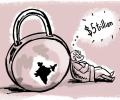
India decisively withstood global headwinds in 2023 and is likely to remain as the world's fastest-growing major economy on the back of growing demand, moderate inflation, stable interest rate regime and robust foreign exchange reserves. Despite widespread pessimism witnessed among the developed nations and the worsening geopolitical situation, India recorded a gross domestic product (GDP) expansion of 6.1 per cent in the March quarter. The growth moved up to 7.8 per cent in the June quarter and was 7.6 per cent in the September quarter. For the first six months of this fiscal, the growth was 7.7 per cent.

The members of Association of Southeast Asian Nations are Indonesia, Malaysia, the Philippines, Thailand, Vietnam, Brunei Darussalam, Singapore, Cambodia, Lao PDR and Myanmar.
Crude oil prices could dip to the low $60s by the end of 2025 after rising to $80 a barrel in the last quarter (October-December) of 2024 - up nearly 10 per cent from current levels, suggest analysts at JP Morgan. The main players in West Asia, including Saudi Arabia and the UAE, have a strong incentive to keep the conflict contained, according to the JP Morgan report.

As per OECD's September estimates, global growth was to be 3 per cent this year and 3.6 per cent in 2016.

The airlines' losses globally are expected to be down from $52 billion in 2021 to $9.7 billion this year and industry-wide profit should be on the horizon in 2023, Director General of IATA Willie Walsh said in Doha on Monday. International Air Transport Association (IATA) represents some 290 airlines comprising 83 per cent of global air traffic. Walsh, in his inaugural speech at the 78th annual general meeting of IATA here, said that while the outlook for airlines globally is positive, the business environment remains challenging.

Indian policymakers are almost alone, alongside the United States, in seeking a hard and multi-sectoral global decoupling from China in the expectation that it will boost their economies, observes Mihir S Sharma.
Indian growth in the rest of this fiscal year and next will be propelled by robust domestic consumption as consumer confidence improves, and by investment, including large increases in government capital expenditure, according to the Asian Development Outlook September 2023. "As slowing exports could foment headwinds for the economy, and erratic rainfall patterns are likely to undermine agricultural output, the growth forecast for FY2023 is revised down marginally to 6.3 per cent," ADB said.

Although as per the IMF-OECD estimates, an incremental growth of 1.8 per cent in global GDP is achievable

Chief Economic Adviser V Anantha Nageswaran on Thursday said cryptocurrencies are akin to 'a world of Caribbean pirates' in the absence of a centralised regulatory authority and are yet to pass the test of a fiat currency. He said that the government is pursuing a 'high-wire balancing act' to ensure that the gains in growth, inflation, and rupee stability of the last four years are not frittered away. He said the recent development in Terra-Luna cryptocurrency, which witnessed a massive meltdown last month, is a 'very important cautionary tale'.

Only India is anticipated to witness better growth momentum among the BRIC bloc
Chief Economic Advisor V Anantha Nageswaran on Thursday expressed hope that the economy will maintain the trend growth rate of 6.5 per cent and above for the rest of the years in the current decade. The economy will close the current fiscal logging in a growth of 6.5-7 per cent, he said, citing the projections of private sector analysts, Reserve Bank of India (RBI) and international agencies like OECD and the IMF. "This appears to be reasonable at this point in time although we will get the data on the fiscal second quarter in a few days, which will give more clarity on these numbers.
Regulatory reform will not stimulate improvements in the informal sector as long as the workers remain at current skill levels.
